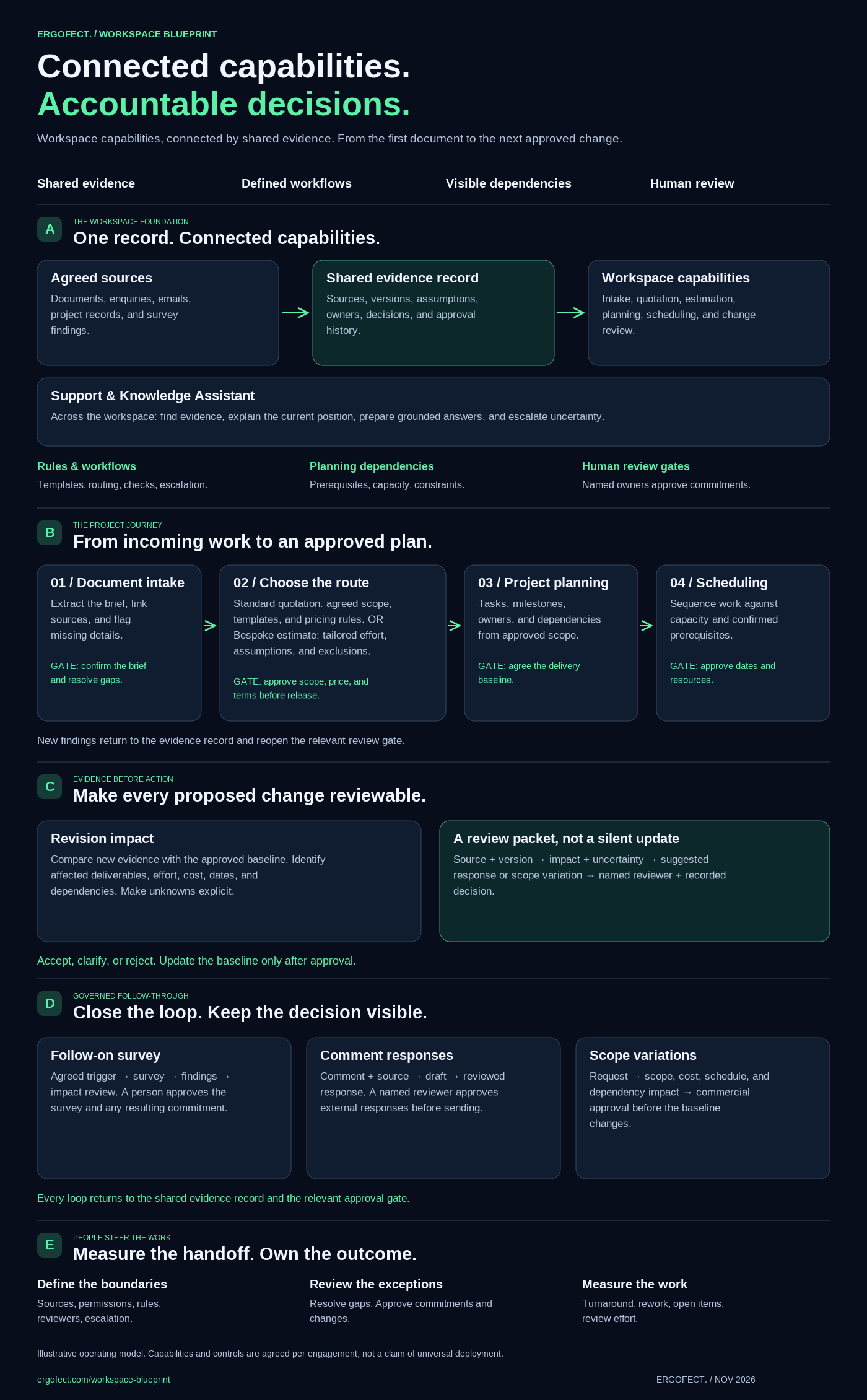
Work arrives in different places.
Documents, enquiries, emails, project records, and survey findings enter through agreed channels.
Ergofect / Workspace blueprint
Workspace capabilities, connected by shared evidence. From the first document to the next approved change, keep the context together and the decisions accountable.
An illustrative operating model, configured around your team, tools, and approval responsibilities.
The workspace foundation
Documents, enquiries, emails, project records, and survey findings enter through agreed channels.
Keep source references, versions, assumptions, decisions, owners, and approval history connected to the work.
Intake, quotation, estimation, planning, scheduling, and change review use the same project context.
Find the relevant evidence, explain the current position, and prepare grounded answers. Missing or conflicting information goes to a reviewer with its source.
The project journey
Extract the brief, link its sources, and flag missing details.
Review gate: confirm the brief and resolve gaps.
Prepare from agreed scope, templates, and pricing rules.
Build a tailored estimate with assumptions, effort, and exclusions.
Review gate: approve scope, price, and terms before release.
Turn approved scope into tasks, milestones, owners, and dependencies.
Review gate: agree the delivery baseline.
Sequence the work against capacity and confirmed prerequisites.
Review gate: approve dates and resource commitments.
New findings return to the evidence record. Changes reopen the relevant review gate before the approved baseline moves.
Evidence before action
Compare the new information with the approved baseline. Identify affected deliverables, effort, cost, dates, and planning dependencies. Keep uncertainty explicit.
Accept, return for clarification, or reject. Update the baseline only after approval.
Governed follow-through
Prepare the next survey from agreed triggers and open questions. Add findings to the evidence record and flag any effect on scope or plan.
Trigger → findings → impact review
A person approves the survey and any resulting commitment.
Connect each comment to its source and revision. Draft a response, identify unresolved points, and retain the approved answer.
Comment → draft → reviewed response
A named reviewer approves external responses before sending.
Turn a change request into a proposed variation with its scope, cost, schedule, and dependency impact.
Request → impact → approved variation
Commercial approval precedes a revised scope or schedule.
Each loop writes back to the shared evidence record and reopens the relevant review gate. Triggers and permissions are agreed for the engagement.
People steer the work
Illustrative operating model. Capabilities, integrations, automation boundaries, and review responsibilities are configured and agreed for each engagement. This blueprint is not a claim that every capability is deployed for every client.